COMPANY:
BELLPOST
YEAR:
2026
ROLE:
SOLE DESIGNER
TIMELINE:
3-6 MONTHS
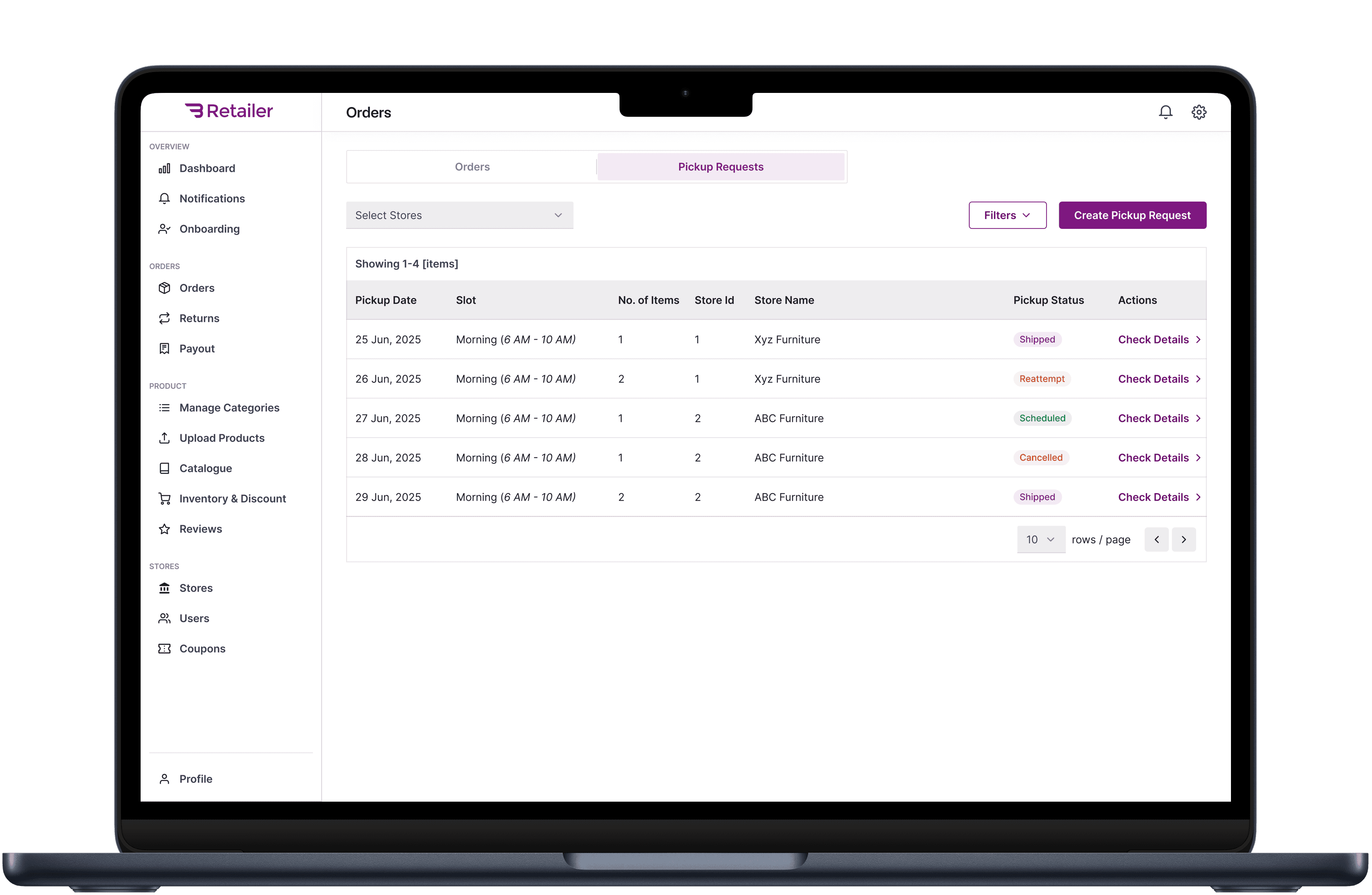
ORDER MANAGEMENT SYSTEM
Designed a seller-side order management system built for scale and simplicity
UX DESIGN
SYSTEM DESIGN
UX RESEARCH
USABILITY TESTING
CROSS TEAM COLLAB
about.
Bellpost is a creator led home goods e-commerce platform, where creators showcase products through videos, enabling users to discover and purchase products directly on the platform.
problem + role.
Small-scale sellers needed a simple, reliable way to manage orders. The operations team needed better control to reduce errors and returns. With a tight timeline, we had to focus on the most important flows and build something that could grow without getting complicated.
I was the sole designer on the seller side doing research, service and system design, wireframing, prototyping, and usability testing. I worked closely with the tech and operations teams, including going through Delhivery API documentation to understand what was actually possible.
research.
The research was focused on 3 key stakeholders - Seller, Delivery Partners and Buyer.
The goal was to understand why small scale home goods sellers are unable to sell their goods online & what are their pain points. Then understand more constraints on delhivery & buyer side.

target user.
During our research, it became very clear that our target users were small-scale retailers with very little digital presence.
That's also how we wanted to differentiate from Amazon and Flipkart. We wanted to give visibility to retailers who weren't getting much elsewhere, and kept low commissions to attract sellers who felt they were losing money on the bigger marketplaces.
constraints.
1
Choosing a delivery partner
Operational cost was one of our biggest constraints. We went with Delhivery because it gave us the most affordable pricing across light and heavy shipments, with pan-India reach.
2
Incomplete API documentation
While going through Delhivery's API docs and testing with the tech team, we found gaps in the docs, leading to a lot of back and forth with Delhivery to understand how things actually worked.
3
Pickup slots that weren't really slots
We gave Delhivery a specific date and time slot for pickup, but the field executive showed up at any time of the day. That single gap changed how we had to design the pickup flow.
brainstorming & ideation.
benchmarking

brainstorming

designing the system.
We mapped the full order journey — receiving an order, packing, pickup, delivery — working closely with tech and ops to understand what was actually possible within our systems and Delhivery's integration.
We explored a few different ways of handling each step and simplified wherever we could, which became the first version of the OMS.

initial iterations.
I did rapid iteration to checkout basic direction we want to go with the design. I chose to go in the direction of highlighted screens.

iteration 1.
Basic happy flow of the seller side order management system.
usability testing 1.
order detail

schedule pickup

iteration 2.
Changed UX after the feedbacks from first round of usability testing. Updated e-inspection and changed schedule pickup flow.
usability testing 2.
e-inspection

create pickup request

final screens.
Changed UX after the feedbacks from second round of usability testing. Removed e-inspection and changed schedule pickup flow.
result.
Designed a streamlined OMS covering the full order journey with minimal complexity and consistent flow.
Built for scalability — supports Delhivery and self-shipment today, with room to integrate other delivery partners later.
Dropped the e-inspection flow to prioritize reliability over shipping solutions with high error potential.
Worked closely with tech to navigate constraints, run usability testing, and manage handoff.